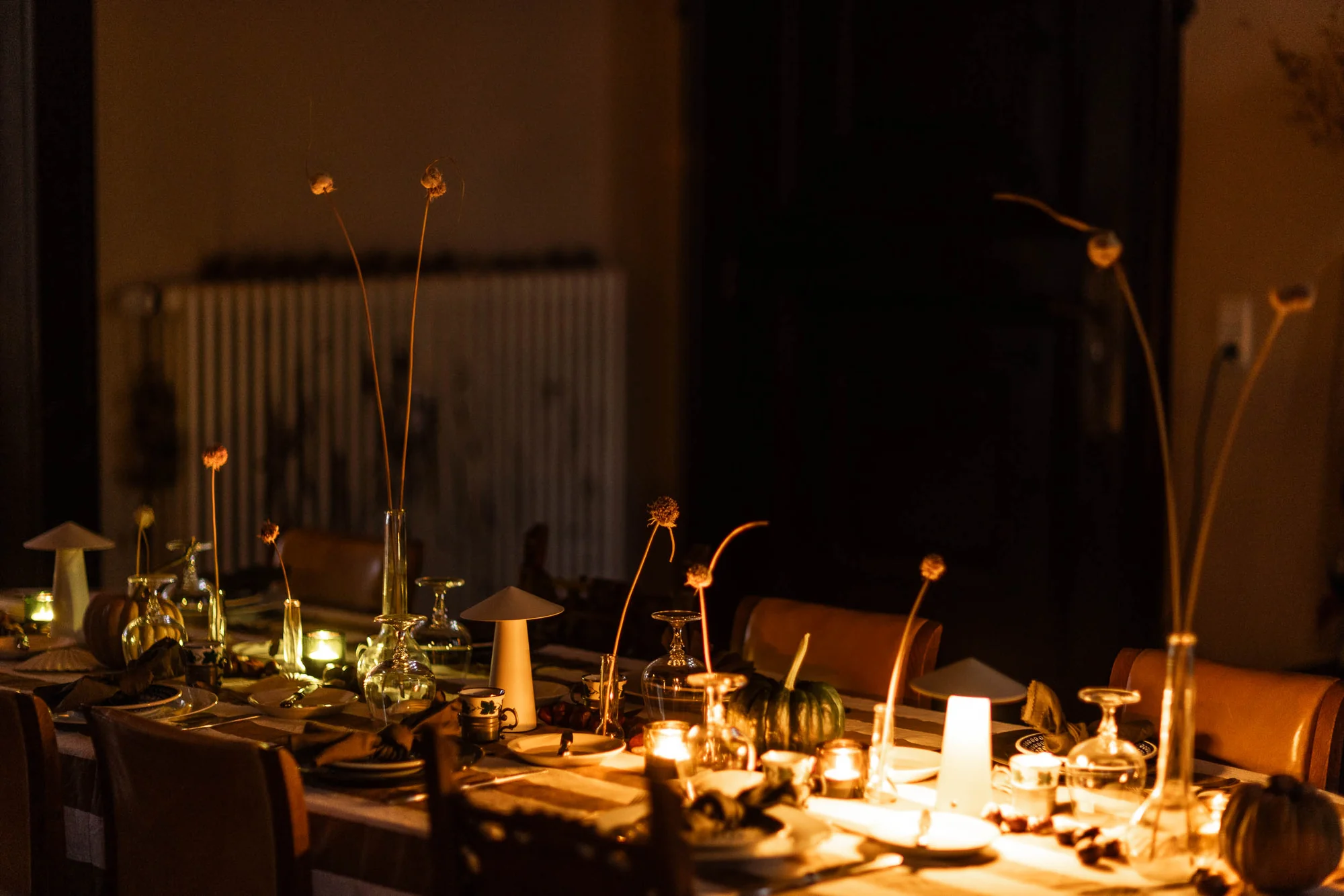
The long table at Villa Oiva laid in a dark room, small table lamps and candles burning, dried allium stems above the runner
Journal · From the Table · October

The best hour
is the one before

By eleven the table will look different. Fuller, louder, better. The way it looks now, only the person who laid it will ever see. The last hour before the last dinner of the season.

Christoph Neumann Journal · From the Table Villa Oiva · Brandenburg October 2026 8 min read Auf Deutsch lesen

There is one hour in every evening that nobody photographs and nobody tells stories about afterwards. It sits between the moment the table is finished and the moment the doorbell goes.

That hour belongs to the house. The glasses stand upside down, waiting to be turned over. The napkins are tied and nobody has pulled one loose yet. The candles have been burning for ten minutes, long enough for the wax to soften, short enough that not one of them has run. Everything is ready and nothing has happened.

It was the eleventh of October, the last warm evening of the year, and the last time this season that a long table would be laid here. April to October, it says so on every page of this site. What it does not say anywhere: every single evening in between is laid with the same care and composed on its own terms. The last one simply carries a thought the others do not. It will be half a year before we do this again.

In short

  • The eleventh of October 2026, the last harvest dinner of the season at Villa Oiva in Brandenburg. Everything on the table came from our own garden, from the avenue outside or from the verge of the lane.
  • This piece is not about the party. It is about the hour before it: laying the table, making the light, picking the flowers, and choosing the record that goes on before the first guest arrives.
  • The table is gathered rather than bought: dried allium heads, small squashes, conkers, rosehips, wild fleabane from the lane, old porcelain, silver left deliberately dull.
  • Four Japanese records played, from the seventies and early eighties. Three of them sold almost nothing when they came out and were found again decades later. The full list is further down.
01 / Twenty to five

A room that has been
waiting since 1895

Before any of it, the room is only a room. The chairs stand against the wall, the table is bare, and the light comes in low from the west through the tall windows, the way October light does. This room has seen it before. It is a hundred and thirty one years old and was built for evenings like this one, with double doors you can open when more people turn up than you planned for.

Laying the table is not preparation for us, it is the beginning of the evening. We do it between the two of us, without hurrying and mostly without talking much. Linen first, then the porcelain, then the cutlery, then the glass. Last of all, everything that is alive or once was.
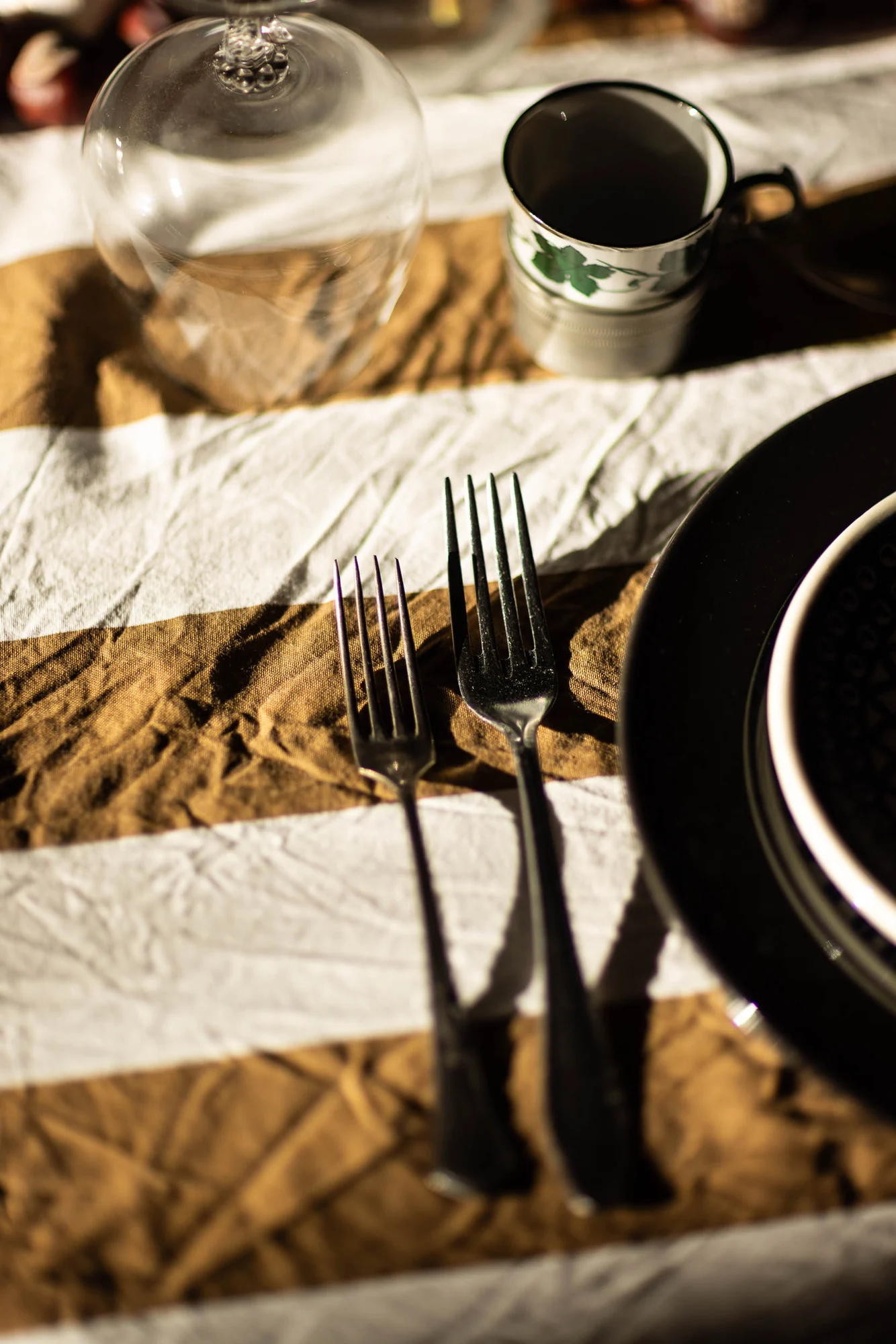
A place setting close up: ochre and white striped linen runner, an upturned wine glass, a cup with a green vine pattern, two old silver forks and a black plate
Hard afternoon sun, twenty minutes of it. After that it does not come back and the rest of the evening belongs to the candles.
02 / Five o'clock

None of it
was bought

The runner is linen in ochre and white. Not an antique, but a piece that reads like one, and that is exactly where the work sits: finding the fabric that sets the mood before anything at all is placed on it. The cups with the green vine are antique, gathered one at a time over years, no two from the same set. The cutlery is plated and tarnished, and we deliberately stop short of polishing it bright. Bright silver looks ordered in. Dull silver looks as though somebody has already eaten with it.

In between goes whatever is left outside. Dried allium heads on bare stems, flowered in June and in the attic ever since. Conkers our son collected, because that is what a four year old does in October. Squashes that stayed too small for the kitchen and are exactly the right size for the middle of a table.

That is the whole trick to an autumn table, if anybody is looking for one. Take what is already there, and take little of it. A table does not need a centrepiece from a florist. It needs objects at three heights and one colour that repeats.

What was on the table that evening
  • Linen runner, ochre stripes chosen with care
  • Dried allium heads garden, June
  • Small squashes, several garden, October
  • Conkers the avenue outside
  • Rosehips hedge at the field edge
  • Wild fleabane the lane, that afternoon
  • Antique cups with a vine pattern gathered one at a time
  • Plated cutlery inherited, left dull
  • Glasses upside down until somebody comes
  • Pillar candles and tealights lit at half past six
  • Small rechargeable lamps where candles are not enough
  • Dark napkins, loosely knotted knotted, not folded
03 / Six o'clock

Flowers that grew
on the verge

An hour before, we went out once more with a bucket and took what stands along the drive. Fleabane, which most people take for camomile. It grows where nobody mows, it lasts three days in water and then it does not, and that is precisely why it is right for a single evening.

Bought flowers have a problem in October. They look like June. What grows outside the door looks like the date you are sitting down on, and that is the only standard we care about.
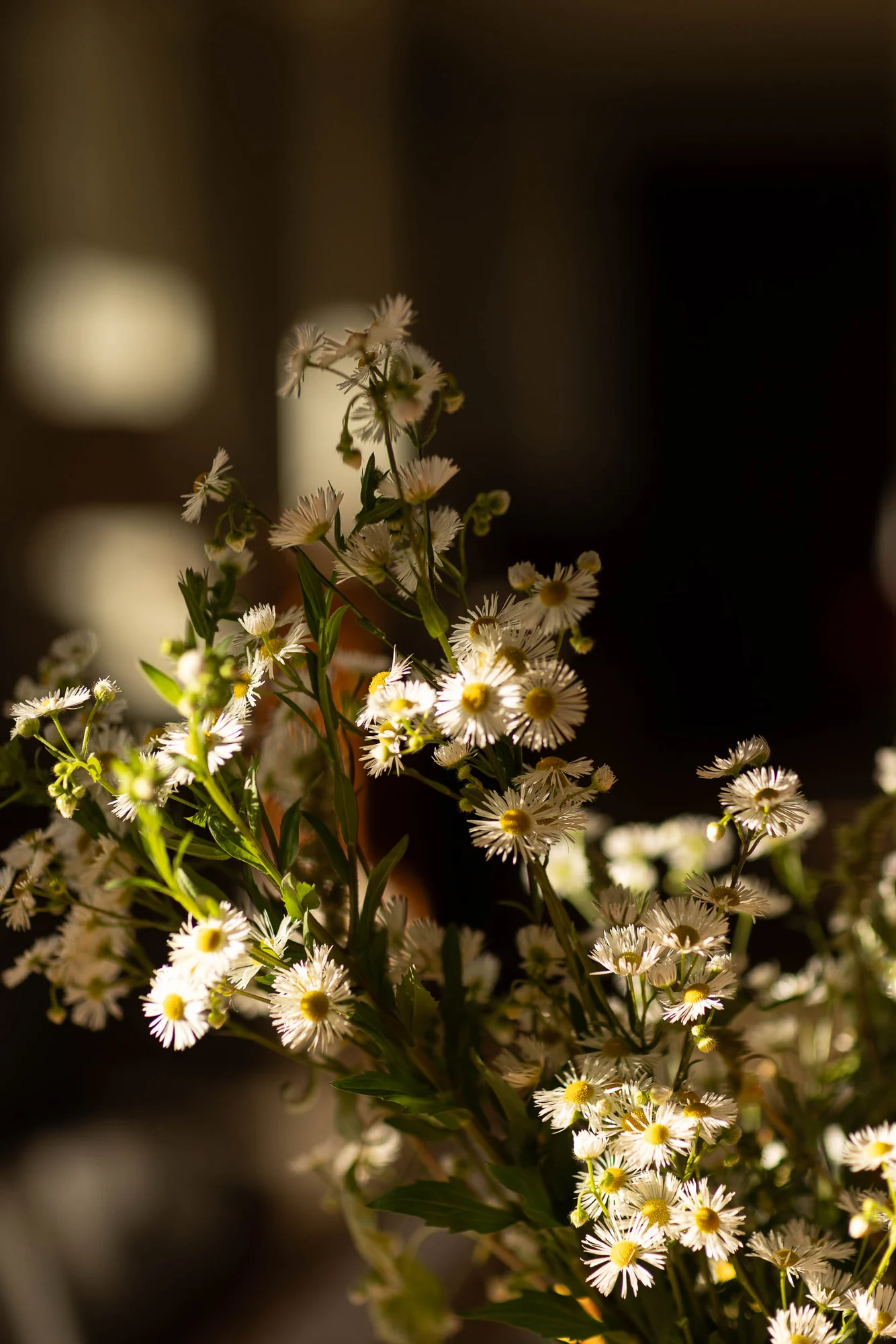
Wild white fleabane in low evening sunlight against a dark room
Fleabane from the lane. Three days and it is finished. For this evening that is plenty.
04 / Half past six

The light gets
made

On an October evening there is a moment when the room tips over. Outside it is still bright enough to see the garden, inside it is already dark enough for one candle to do something. That moment lasts maybe twelve minutes. Light the candles inside it and you have won the evening. Light them early and all you get is candles standing about.

We work with three heights. Tealights at table level, close to the plate, so the faces warm from below. Pillar candles in between. And a few small rechargeable lamps, mushroom shaped, placed where somebody genuinely needs to see something. We thought about those lamps for a long time before they went on this table. They belong there when they are the only thing in the room asking for no attention at all.

After that no ceiling light goes on. Not while serving, not while clearing, not at half past midnight when somebody is looking for a phone. It is the one rule of the evening.
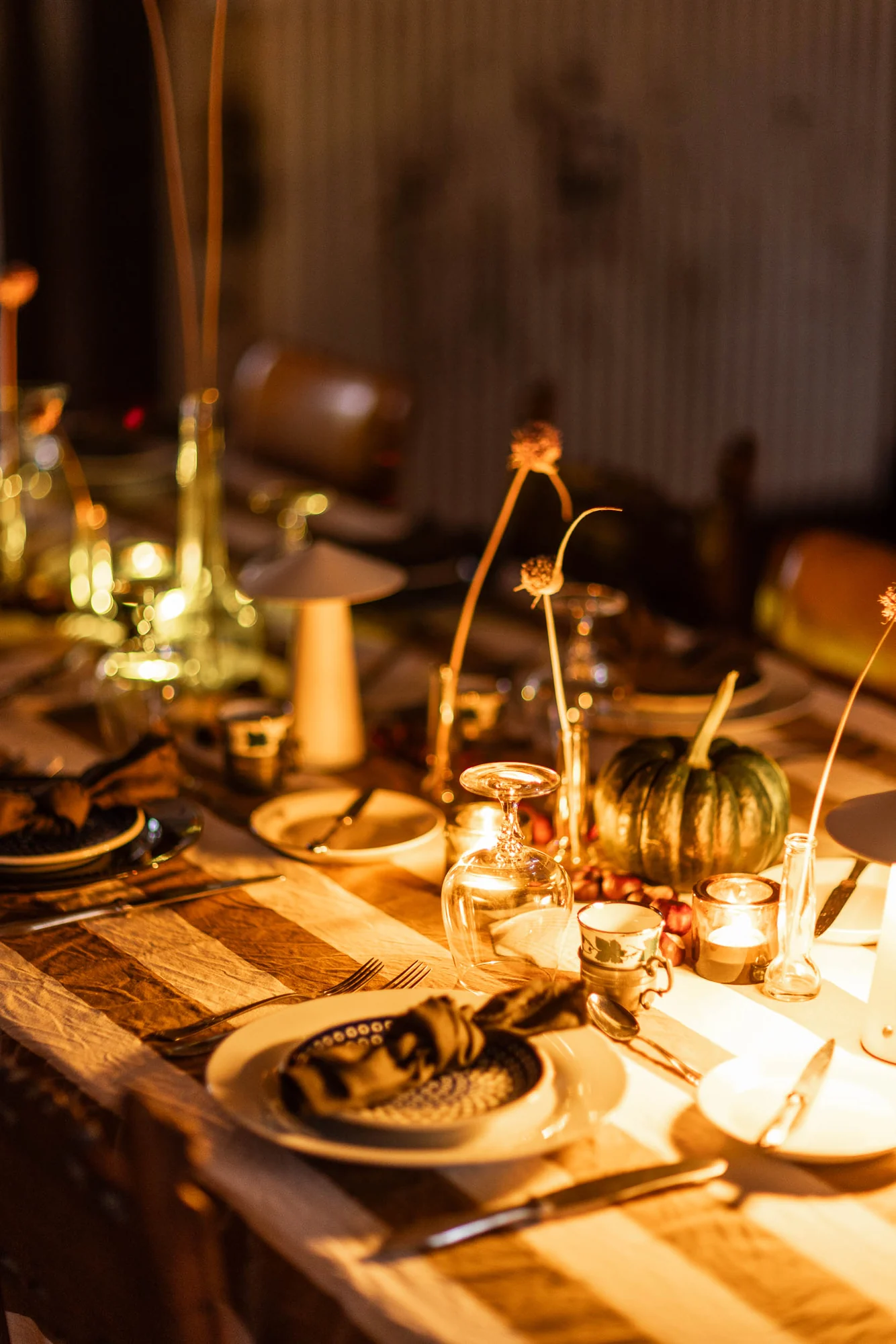
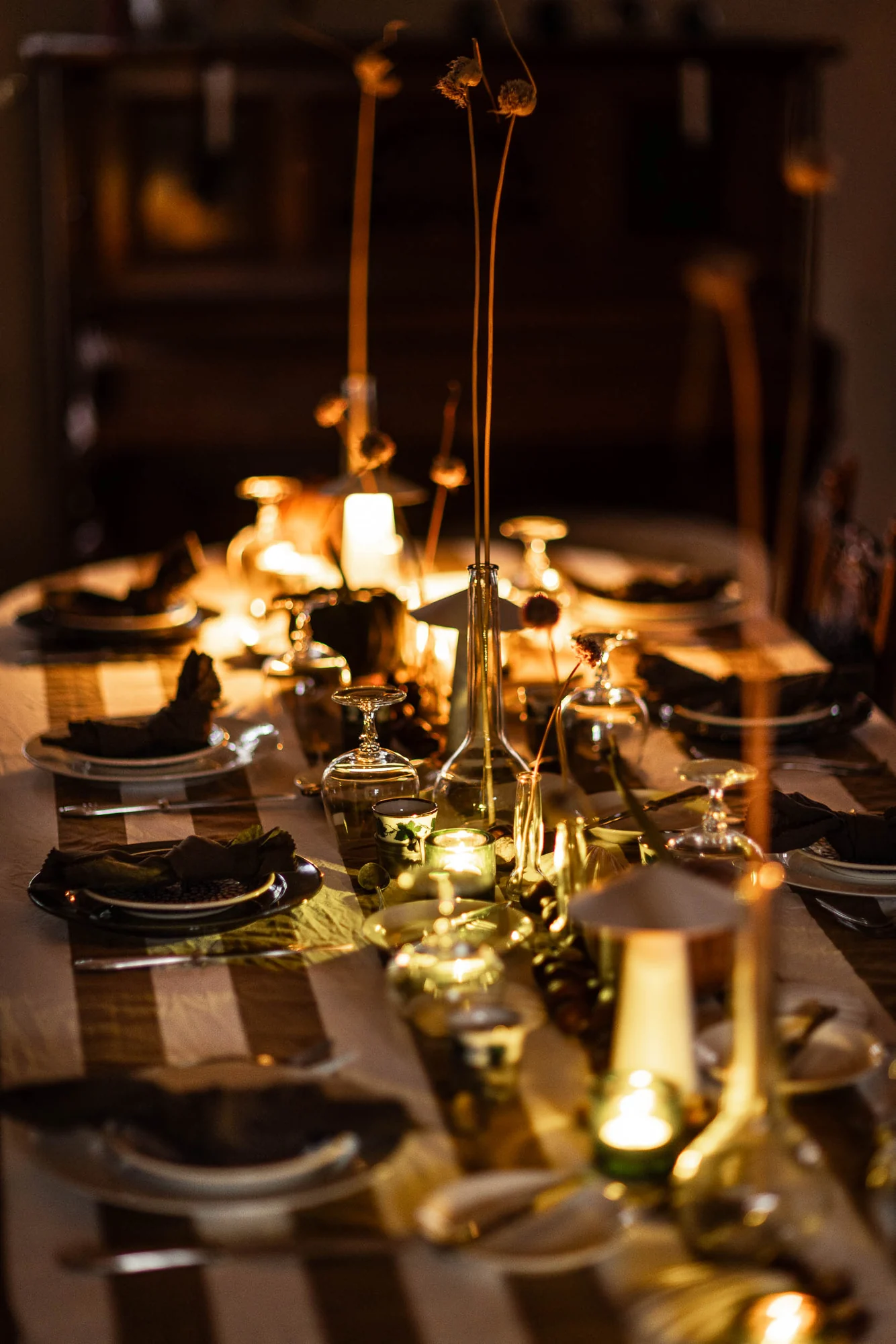
Table detail at dusk with a small green squash, rosehips, a tealight, dried allium stems and a knotted napkin on the plate
Three heights of light and squashes that stayed too small for the kitchen. The napkin is knotted rather than folded, which takes two seconds and reads as intent.
05 / Ten to seven

Four records that waited
a long time for this evening

Japanese jazz from the seventies sounds as though it was recorded for exactly this light. Warm, quiet, in no hurry at all. Four records in this order, from twenty to five until the doorbell.

  • I.
    Midori Takada
    Through the Looking Glass
    RCA · 1983

    For the empty room. Takada recorded it in three days and played every part herself: marimba, gongs, reed organ, bells, ocarina, piano and empty Coca-Cola bottles. Music for a room nobody is sitting in yet.

  • II.
    Ryo Fukui
    Scenery
    Trio Records · 1976

    For the laying of the table. Cut in a single day in Sapporo in July 1976. Side A opens its way into "Early Summer", side B closes with "Autumn Leaves". A record that travels from June to October in forty minutes, which is exactly the distance we have just come.

  • III.
    Hiroshi Suzuki
    Cat
    Nippon Columbia · recorded October 1975

    For the candles. Trombone, slow, entirely unhurried. Recorded in Tokyo in October 1975, almost exactly fifty one years ago and in this same month. "Romance" from side A is the track somebody at the table always asks about.

  • IV.
    Tsuyoshi Yamamoto Trio
    Midnight Sugar
    Three Blind Mice · 1974

    For the last few minutes. The label was founded in Tokyo in 1970 to give young Japanese musicians a record of their own, and became famous along the way for how its records sound. You hear the room they played in. That is the thing to be listening to just before your own room fills up.

What these four have in common. Three of them went nowhere when they appeared. Takada's record was not a success, Suzuki's Cat barely sold, and Fukui stayed unknown outside Sapporo for years. They were found decades later, through YouTube, by people who had not been looking for them. Suzuki's "Romance" now has more than eleven million plays. He died in 2020, three years before it finally got a video. It suits this hour that the turntable is stacked with things that waited a long time for somebody to arrive.

06 / Seven o'clock

In a moment
it gets loud

The last walk through the room is always the same. Once along the table, checking whether every setting sits the same distance from the edge. It never does. You move two plates a centimetre to the left, nobody will ever notice, but you have seen it and now you can stop.

Then you stand still for a second and look at the table the way nobody but us gets to see it. In half an hour there will be breadcrumbs on the linen, two glasses in the wrong places and a chair turned away because somebody moved to talk to somebody else. That is when the evening is exactly right.

Which is why these photographs exist. Not because the empty table is lovelier than the full one, but because the full table tells its own story and the empty one needs somebody to write it down.

The long table seen end on by candlelight, upturned glasses, dark napkins and dried allium heads in a green bottle
Seven o'clock. From here the evening stops belonging to us.
Frequently asked

What people ask us
about the table

How do you lay an autumn table without it looking like decoration?

Take everything from the same place and take little of it. Dried seed heads, small squashes, conkers, rosehips and one wild plant from the verge are plenty for a long table. What matters is three heights, so something flat on the runner, something at glass height and a few tall stems above that, plus one colour that repeats. Bought arrangements mostly look like June when you put them out in October.

Which flowers work on an October table?

Whatever is still standing outside. For us that is wild fleabane from the lane, dried allium heads from June, fennel seed heads and spent sunflowers. None of it lasts more than a few days, and that is exactly why it looks like the evening it was cut for. For one evening that is not a drawback.

How many candles does a long table need?

More small ones than large ones. We reckon on one tealight per setting, close to the plate, plus a pillar candle down the centre every sixty to eighty centimetres. Tealights at table height soften faces, tall candles make the room. Light them at the moment dusk starts outside, which here in October means around half past six.

Do rechargeable lamps belong on a laid table?

If they are quiet, yes. We put a few small mushroom shaped lamps where somebody genuinely needs to see something, warm white and dimmed right down. They do not replace a candle, they replace the ceiling light. The ceiling light stays off all evening, clearing up included.

What music do you play on an evening like this?

Japanese jazz from the seventies and early eighties, on vinyl. That evening it was four records in this order: Midori Takada, "Through the Looking Glass" from 1983, Ryo Fukui, "Scenery" from 1976, Hiroshi Suzuki, "Cat", recorded in October 1975, and the Tsuyoshi Yamamoto Trio with "Midnight Sugar" from 1974. Warm, quiet, unhurried, and loud enough that a silence at the table never turns awkward.

Why vinyl instead of a playlist?

Because a side lasts twenty minutes and then somebody has to get up. That sounds like a drawback and it is the actual reason. Every twenty minutes one person stands up, crosses the room and turns the record over, and the evening gets a rhythm no algorithm manages.

Can we book an evening like this?

Yes. The long table is the heart of everything that happens here, for weddings, birthdays, company dinners and residencies. It is laid the way it is described here, and we cook with what grows twenty metres from the kitchen. The season runs from April to October and we take enquiries all year.

About the author
Christoph Neumann

Photo designer and videographer with more than 25 years of professional experience across portrait, people, editorial and corporate work, as well as architecture and interior photography. Together with his family he runs Villa Oiva, an 1895 Jugendstil villa in Brandenburg whose permaculture garden supplies the kitchen of the house. Every photograph in this piece was made in the house on 11 October 2026, between twenty to five and seven o'clock. christoph-neumann.com

Read next

Published · photographed on

The table is laid again from April

From April to October we lay the long table for weddings, family celebrations and residencies. If you want to sit at it next summer, winter is the time to ask.